
A top-tier Client in Saudi Arabia needed a way to rate banks that captured both established credit risks and the new ones emerging with FinTech. We designed a bank rating and credit scoring model that combines traditional credit metrics with innovation-linked factors aligned to Vision 2030.
- Location
- Saudi Arabia
- Sector
- Banking
The Brief
The Client asked us to design a bank rating and credit scoring model for use in the Saudi market.
The model needed to integrate traditional credit metrics with innovation-linked factors, reflecting the priorities of Vision 2030 as the Kingdom's financial sector modernizes.
The Obstacle
To be comprehensive and actionable, the model had to cover every relevant risk dimension, leaving no gap that could weaken a rating.
It also had to stay consistent and reliable while reflecting two very different kinds of risk: the legacy financial risks banks have always carried, and the emerging risks that come with new technology.

Our Approach
We applied a top-down framework that moves from macroeconomic risk to sectoral, business and financial risk indicators, so each rating reflects the conditions a bank operates in as well as its own performance.
We then developed a methodology that bridges FinTech disruption with conventional risk scoring practices, bringing emerging risks into the same consistent framework.
What We Delivered
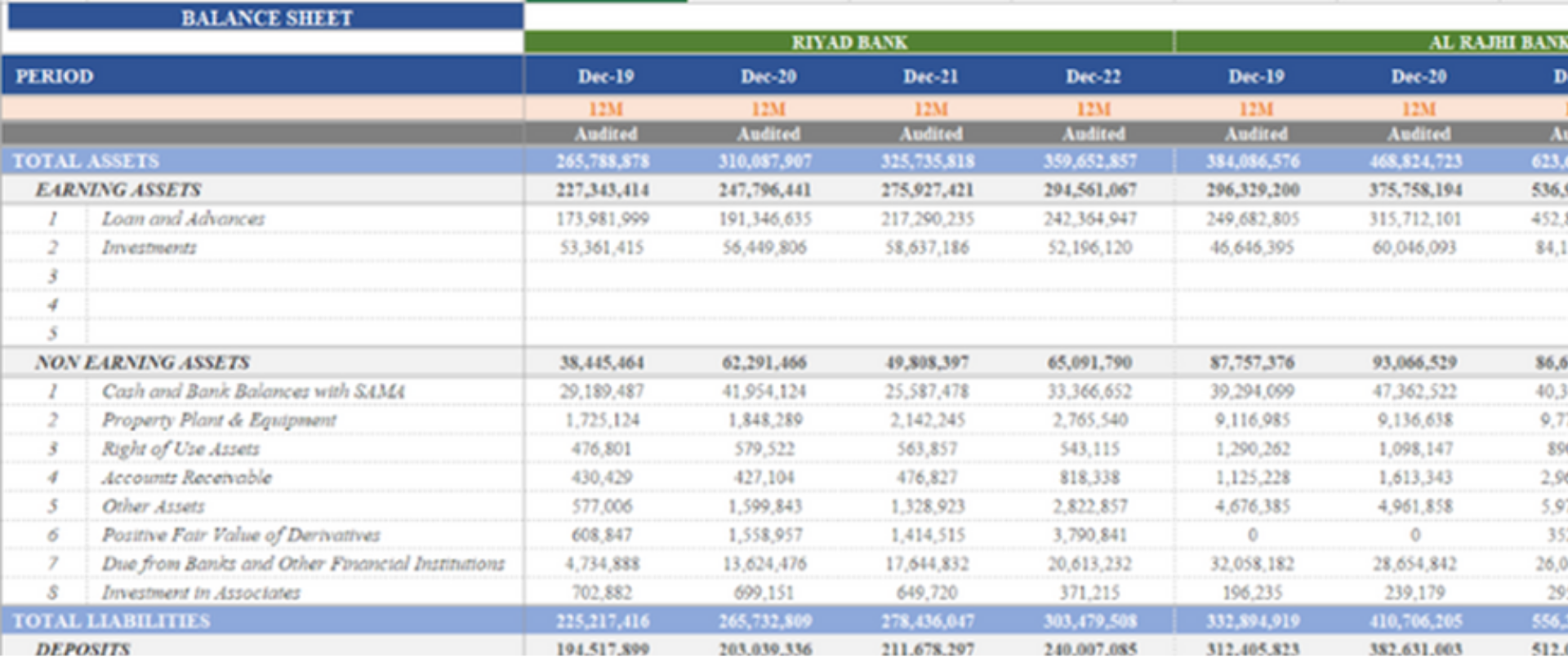
The engagement delivered a bank rating and credit scoring model built on more than 10,000 data points to strengthen its accuracy and reliability.
- Four-layer framework covering macro, sectoral, business and financial risk indicators.
- Integrated a forward-looking methodology – FinTech disruption and Vision 2030 factors – into conventional credit scoring.
Our Impact
The model was adopted as a core tool for evaluating banking credit risk.
Its success led to new mandates to develop rating systems for other financial sectors.